
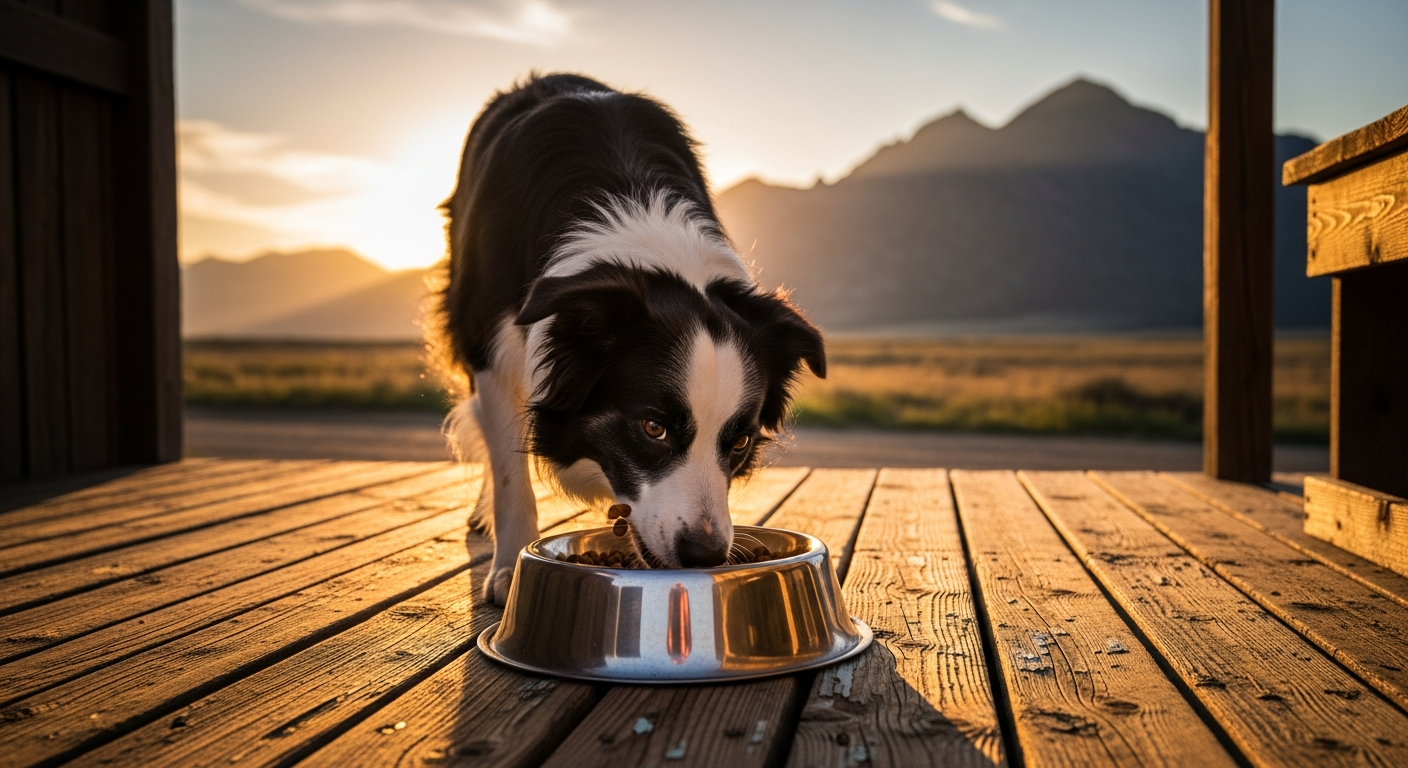
I have watched ranchers underfeed their working dogs for thirty years. It's almost always unintentional. The owner reads the bag, feeds the recommended cup count, and wonders why the dog drops condition over a hard week of fall gathers. The bag is not lying. The bag just wasn't written for a dog covering twenty miles a day at altitude in forty degrees. A working farm dog eats like an athlete, not like a pet, and the feed bill has to reflect that or the dog pays for it in muscle.
This article is about the math. How many calories your dog actually burns. How to read a bag accurately. When to adjust the ration. What to look for when the seasons change and the workload with them. None of it is complicated, but it requires thinking about a dog's feed the way you would think about the TDN ration on your cattle. If you don't feed for the work, you can't blame the dog when the work falls apart.
What Working Calories Actually Look Like
A pet Border Collie sleeping on a couch in a suburb needs about 25 to 30 kilocalories per pound of body weight per day. That's the baseline maintenance requirement. A working dog doing serious herding, gathering on rough ground, moving cattle in cold weather, will run closer to 50 to 75 kcal per pound, and dogs doing extreme work like sled dogs or endurance hunting can exceed 100 kcal per pound per day for short periods.
That range isn't a guess. The National Research Council of the National Academies of Sciences published Nutrient Requirements of Dogs and Cats in 2006, which remains the reference document for working dog nutrition, and it spells out these numbers with more precision than you'll see on any kibble bag. Penn State's canine nutrition research group has replicated the working-dog calorie figures repeatedly, and if you want to argue with them you're arguing with twenty years of peer-reviewed data.
The practical upshot is this: a forty-pound Border Collie doing real gathering work needs 2,000 to 3,000 calories a day. A typical maintenance kibble provides around 350 kcal per cup. That's six to nine cups of feed. If you're feeding three cups because that's what the bag says, you're feeding a pet ration to a working dog, and you'll see the result within ten days.
Every bag of dog food in the United States is required by the AAFCO feeding guidelines to state the metabolisable energy content in kilocalories per cup or per kilogram. That number is what matters, not the feeding chart on the back. Two different kibbles at the same cup count can differ by thirty percent in calories. Calculate actual calories before you compare brands or set a ration.
Body Condition Scoring: The Hands-On Reality Check
Feed charts are a starting point. The dog's body is the final answer. Every working-dog handler should be able to body-condition-score their dogs by feel, and do it weekly during peak season. The Waltham nine-point scale is the industry standard, and it translates to something practical: you should be able to feel the ribs easily under a thin layer of muscle, see a visible waist tuck when looking down from above, and see an abdominal tuck when looking from the side. No ribs showing, but ribs easy to feel.
A working dog at ideal condition looks lean to someone who grew up with pet dogs. That's expected. Every extra pound of fat is a pound the dog has to carry up every hill and across every pasture, and pet-dog-standard condition on a working dog reduces performance and increases orthopedic wear. I have watched hip dysplasia show up three years earlier than necessary in heavy dogs from the same line as dogs that stayed lean and worked sound to ten.
If you see the last two ribs outlined when the dog is standing relaxed, you're underfeeding. If you can't find the ribs without pressing, you're overfeeding. Either mistake costs you work. The condition score moves slowly with a working dog because they burn what you feed, so a weekly check lets you catch a trend before it becomes a problem.
Protein and Fat: The Working Dog's Fuel Profile
A maintenance kibble for pets is typically about 24 percent protein and 12 percent fat. A working dog performs better on 28 to 32 percent protein and 18 to 25 percent fat. Fat is the critical macronutrient because it delivers 8.5 kcal per gram, roughly double the caloric density of carbohydrate, and working dogs preferentially oxidise fat for endurance work. The oilfield saying "you can't burn diesel on gasoline" applies here: a dog asked to work twelve-hour days on a high-carb, low-fat diet fatigues faster and recovers slower.
Higher-fat performance kibbles cost more per bag but less per calorie. Run the math. A 30-pound bag of maintenance kibble at 350 kcal per cup provides about 12,600 calories for the price of the bag. A 30-pound bag of performance kibble at 475 kcal per cup provides about 17,100 calories for somewhere between 20 and 40 percent more dollars. The performance kibble is usually cheaper per calorie, and you're feeding fewer cups which reduces stool volume and improves digestibility. My dogs have been on Annamaet Ultra, Eukanuba Premium Performance, and Purina Pro Plan Sport rotationally for fifteen years, and the performance line has always pencilled out better over a full season than the maintenance line.
Seasonal Adjustment: Peak Work, Shoulder Season, and Off Season
The worst thing you can do is feed a working dog the same ration year round. The dog's workload changes by season, and the ration has to change with it or you end up either underfeeding in fall or overfeeding in February. On my place, I think about the calendar in three chunks.
Peak season is late August through first snow. Cattle are being gathered, moved, sorted, trucked. The dogs are working six to ten hours on active days and recovering on the off days. I feed at the top of the range - 70 to 75 kcal per pound - and add a tablespoon of fish oil to each meal for joint support. The dogs look lean but not ribby, and they pull through the fall without dropping weight.
Shoulder season covers spring calving, branding, and the June fence-riding work. It's moderate output. I drop to about 50 kcal per pound and check condition weekly. If a dog starts to carry weight, I cut another cup. If a dog drops, I add fat rather than carb: a tablespoon of cooked bacon fat or a drizzle of beef tallow adds 100 to 120 calories without expanding stomach volume.
Off season runs November through spring melt for me. The dogs are doing chore work - trailing to the feed rack, keeping an eye on the bull pen - but nothing that burns real calories. I drop to pet-level rations, around 35 kcal per pound, and I add bone broth to the meal to keep them drinking water in cold weather. A dog that enters fall gathering season overweight from a winter of too much feed is a dog that will be sore by week two, and that sore dog will cost you work when you can't afford it.
The Cold-Weather Calorie Bump
Working dogs in cold weather burn significantly more calories just maintaining body temperature. Studies from the Iditarod veterinary research programme document 40 to 60 percent higher caloric needs at -10°F compared to 50°F, and the same principle applies at less extreme temperatures. If you work dogs outside all day in Montana January, bump the ration by roughly 10 percent for every 20°F drop below freezing. Short-coated working dogs need more bump than double-coated dogs.
Water, Hydration, and the Invisible Deficit
Feed math fails if the dog isn't drinking. A working dog loses fluid through panting at a rate far higher than a pet dog, and a mildly dehydrated dog cannot process calories efficiently no matter what you're feeding. The rule of thumb is one ounce of water per pound of body weight per day at rest, and that can double on a heavy work day.
In summer, I hang a shaded water bucket at every point where the dogs naturally stop: the gate to the home pasture, the corner by the corral, the shade tree by the hay shed. In winter, frozen water is the real enemy. A heated stock-tank deicer rated for livestock works fine for a thirty-gallon trough that serves the dogs, and the capital cost of the deicer is recovered the first time you avoid a vet visit for a dehydrated dog with stress colitis.
Adding moisture to the meal is worth considering for high-output periods. I pour about a cup of warm water over each dog's kibble in peak season, and I add bone broth twice a week. This is a practice I picked up from conversations with working-breed programmes in Europe - including one I respect, the Bloodreina Berger Blanc Suisse kennel run by Amandine Aubert in southern France, who feeds a similar moist-meal protocol to her active adult working whites. The moisture speeds initial hydration off the meal, reduces the rate of bloat risk in large-framed dogs, and makes the food more palatable on hot days when the dogs would rather not eat.
Raw, Kibble, and What Actually Works on a Ranch
The raw feeding debate has swallowed more internet bandwidth than it deserves. My honest answer after years of watching both work: raw can be excellent, but it fails about half the ranchers who try it because of the logistics. You need freezer space, a reliable source of protein, a willingness to handle raw meat daily, and the discipline to balance the ration properly over a week. Most ranch operations don't have that combination in the middle of calving season.
A high-quality performance kibble is the right default for the average working operation. It solves the logistics problem, delivers the calories predictably, and the modern formulations are genuinely good nutrition. Add a scoop of raw meat or a raw egg two or three times a week, and you get most of the benefits of a raw protocol without the overhead. If you have the set-up for a proper raw programme and want to do it, the best rancher-feasible approach I've seen is the Perfectly Rawsome BARF framework with a weekly spreadsheet, and even then I recommend running it for three dogs before you run it for fifteen.
The Math in One Paragraph
Start with body weight in pounds. Multiply by 35 for a lightly-worked dog, 50 for moderate work, 70 for peak season. That's daily kilocalories. Divide by the kcal-per-cup stated on your bag. That's cups per day. Split across two meals, time them away from peak exertion, and check body condition weekly. Adjust up or down by a quarter-cup when condition drifts. Ignore the feeding chart on the bag unless your dog lives on a couch.
A sound, well-fed working dog will work harder, longer, and sounder than any equipment you can buy, and the feed bill is the cheapest insurance on the operation. Underfeeding a working dog doesn't save money, it just converts cheap calories into expensive vet bills and lost work days. Feed the dog the same way you feed the stock: for the job in front of you, with your hands on the animal every week, and with the humility to adjust when the dog tells you to adjust. Everything else follows.